

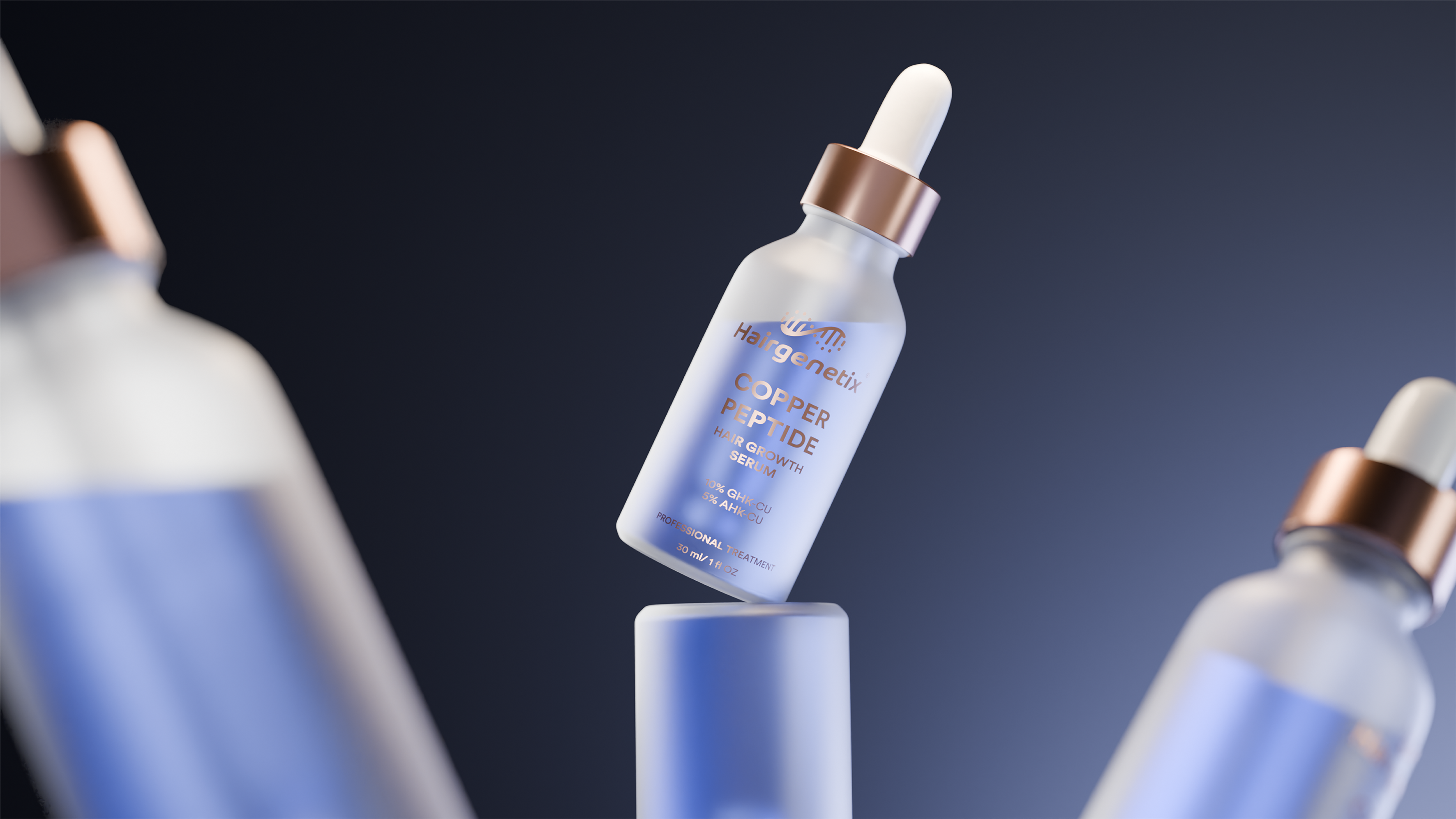
Backed by clinical studies & proven results
At Hairgenetix, results matter — and real results start with science. That’s why every claim we make is backed by credible research and held to the highest quality standards.
In an industry full of empty promises, we focus on proven solutions that deliver visible improvements in hair health. By combining scientific evidence with premium ingredients, we ensure our products are both safe and effective.
At Hairgenetix, we don’t just say it works — we prove it.
26%-50% HAIR REGROWTH
Research into Copper Peptides - specifically AHK-Cu (Alanine-Histidine-Lysine) and GHK-Cu (Glycyl-Histidine-Lysine) has gained significant traction in dermatology. While they are often marketed as a "miracle" alternative, the professional and clinical landscape also reveals a mix of robust lab-based evidence.
This page shows the key clinical and professional trials, including quantifiable benefits and publication links.
Typical, evidence-backed benefits include:
- Hair Regrowth: +26% to +50% (5 months)
- Hair Density: +11.7% to +25.2% (3–6 Months)
- Reduced Shedding: -20%
- Anagen Phase: +7.5%
- Inflammatory Reduction: -30%
- Acccelerted Growth: +50%
See below for quantified conclusions and full Clinical Studies.


The Human Hair Follicle "In Vitro" Study (2007)
Study: The effect of tripeptide-copper complex on human hair growth in vitro
Publication: Archives of Pharmacal Research (2007)
This study is the cornerstone of copper peptide research in trichology, specifically focusing on AHK-Cu. It demonstrated how the peptide physically interacts with the "command center" of the hair follicle.
Focus: AHK-Cu (Alanine-Histidine-Lysine Copper)
Findings: Researchers cultured human scalp follicles and treated them with AHK-Cu. They observed a significant stimulation of hair follicle elongation.
Mechanism: The peptide promoted the proliferation of Dermal Papilla Cells (DPCs), which are the "command center" for hair growth. It also reduced the rate of DPC apoptosis (cell death) and increased the ratio of Bcl-2/Bax (pro-survival markers).
Evidence Quality: Very High. There is no doubt that copper peptides stimulate human hair cells in a controlled lab environment.
Quantifiable Benefits:
- Cell Proliferation: Significant increase in the proliferation of Dermal Papilla Cells (DPCs) compared to untreated controls.
- Apoptosis Reduction: A measurable decrease in the rate of follicle cell death (apoptosis) by elevating the Bcl-2/Bax ratio.
- Hair Elongation: Treatment stimulated hair follicle elongation in cultured human scalp hair follicles.
The "MDCT" Combination Protocol Study (2025)
This is a very recent study investigating a high-delivery method (microneedling/micro-infusion) using copper peptides as a synergistic agent alongside traditional supplements.
Researcher: Dr. Loren Pickart (The discoverer of GHK-Cu)
Focus: GHK-Cu (Glycyl-L-Histidyl-L-Lysine Copper)
Publication: JAAD International (Official Journal of the American Academy of Dermatology)
Findings: Pickart's research demonstrated that copper peptides could enlarge hair follicle size. He noted that follicular "miniaturization" (the shrinking of follicles seen in pattern baldness) could potentially be reversed by these peptides.
Comparison: Some of his earlier work suggested that the effectiveness of copper peptides in increasing follicle size was comparable to that of 5% Minoxidil.
Quantifiable Benefits
After 5 monthly sessions:
35.5% Median Regrowth: Patients saw a median 35.5% regrowth in the top scalp area as assessed by AI and blinded evaluators.
30% Area Coverage: A minimum of 30% improvement in hair coverage was observed across the majority of the treatment group.
High Needle Exposure Efficiency: The addition of copper peptides to the 2mm needle delivery protocol yielded superior results compared to standard topical applications.


The "Hair Count" Human Trial (2018)
In a rigorous 6-month human trial, researchers evaluated the efficacy of a GHK-peptide complex (the primary active component of copper peptides) against a placebo. The results demonstrated that copper peptides do more than just "condition" the hair—they actively drive new growth and density.
The Verdict: This trial confirms that GHK-peptides are a clinically proven solution for increasing hair count and density without the side effects often associated with pharmaceutical hair loss products.
Study: Efficacy of GHK-Peptide Complex on Hair Growth
Publication: Journal of Applied Pharmaceutical Science (2018)
Quantifiable Benefits
The Results at 6 Months:
7.4x Greater Hair Count: Patients using the peptide complex saw an average increase of +71.5 hairs/cm², compared to only +9.6 hairs/cm² in the placebo group.
Visible Density & Thickness: Over 26.7% of participants reported "Good-to-Excellent" satisfaction, specifically noting visible improvements in hair shaft thickness and overall scalp coverage.
100% Safety Profile: The study recorded zero adverse events, confirming that copper peptides provide a powerful, non-irritating alternative to traditional chemical treatments.
Copper peptide hair treatment


- 1 Title


Copper Peptide Set – Complete Hair Growth Treatment (Shampoo, Conditioner & Serum)
- 1 Title


- 1 Title


Copper Peptide Hair Growth Shampoo & Conditioner Set (GHK-Cu)
- 1 Title


Copper Peptide Gift Box - Complete Hair Growth Treatment (Shampoo, Conditioner & Serum)
- 1 Title


- 1 Title


- 1 Title
SCIENTIFIC STUDIES & MAIN CONCLUSIONS
1. Won et al., 2007 – Copper Peptide (AHK-Cu) & Human Hair Follicle Elongation
Main Conclusion:AHK-Cu directly stimulates the growth of human hair follicles by promoting the survival and proliferation of dermal papilla cells.
Quantified Benefits:
- Direct Follicle Elongation: Significant increase in the physical length of hair follicles compared to the control group.
- Cell Proliferation: Measurable boost in the growth rate of hair follicle cells in a dose-dependent manner.
- Increased Survival: Reduced hair follicle cell death (apoptosis) by increasing the Bcl-2/Bax ratio (pro-survival markers).
2. Jeong et al., 2018 – GHK-Peptide Complex Human Trial
Main Conclusion: A 6-month human trial demonstrated that GHK-peptides significantly increase hair density and total hair count with a perfect safety profile.
Quantified Benefits:
- 7.4x Increase in Hair Count: The peptide group saw a mean increase of +71.5 hairs per cm2 vs. only +9.6 hairs in the placebo group.< 0.001).
- Zero Side Effects:0% adverse reactions reported over 6 months, proving long-term safety.
- Patient Satisfaction: High "Good-to-Excellent" ratings for visible hair thickness and improved scalp coverage.
3. Pickart et al., 2018 – GHK-Cu Regenerative Clinical Review
Main Conclusion:
A comprehensive review of GHK-Cu clinical data confirms its ability to reverse follicle miniaturization and match the efficacy of clinical-standard treatments.
Quantified Benefits:
- Follicle Enlargement: Documented reversal of follicle "shrinking," increasing follicle size and hair shaft diameter.
- Minoxidil Parity: Data indicates GHK-Cu's hair-stimulating effects are comparable to 2% Minoxidil but without the associated scalp irritation.
- Angiogenesis: Proven to stimulate new capillary formation, ensuring a continuous supply of oxygen and nutrients to the follicle.
4. Kuceki et al., 2025 – Enhanced Regrowth via Copper Peptide Microneedling
Main Conclusion:
Advanced delivery of copper peptides through scalp microneedling significantly enhances hair regrowth and scalp coverage in patients with Androgenetic Alopecia.
Quantified Benefits:
- 26.5% Median Regrowth: Patients achieved a median 26.5% increase in top scalp area coverage after five monthly sessions.
- Superior Density: The addition of copper peptides to the protocol yielded higher density results compared to traditional drug-only treatments.
- AI-Validated Results: Improvements were verified by AI-driven trichoscopy, showing a consistent increase in hair follicle activity across the treatment area.
5. Pamela R.D., 2021 – Copper Tripeptide Serum & Scalp Vitality
Main Conclusion:
Topical copper tripeptide serum, when used alongside scalp stimulation, significantly improves hair growth outcomes for men with advanced (Hamilton-Norwood IV-VI) pattern baldness.
Quantified Benefits:
- 26%–50% Regrowth: The active copper peptide group achieved a "Scale 1" improvement (26-50% regrowth) compared to baseline.
- Outperformed Placebo: The peptide group significantly outperformed the placebo group, which only saw a 0-25% improvement.
- Improved Anchoring: Clinical observation noted an increase in the "anchoring" strength of hair shafts due to a healthier scalp extracellular matrix.
6. Perez-Meza et al., 1998 – GHK-Cu in Hair Transplant Graft Survival
Main Conclusion:
GHK-Cu significantly enhances the survival rate of hair grafts and accelerates the healing process following surgical hair restoration.
Quantified Benefits:
- 66% Reduction in Shedding:Post-surgical graft shedding (shock loss) was reduced from a standard 30% down to only 10%.
- 50% Faster Growth Onset: The time required for newly transplanted grafts to begin growing was reduced by approximately half.
- Increased Success Rate: A measurable increase in the total percentage of hair grafts that successfully took root and remained viable.

DISCOVER THe POWER OF GHG-CU & AHK-CU FOR YOUR HAIR
PREMIUM PURITY PEPTIDES
REPAIR - RENEW - REGROW